What is Xperiflow Business Rules (XBR)?
What is XBR?
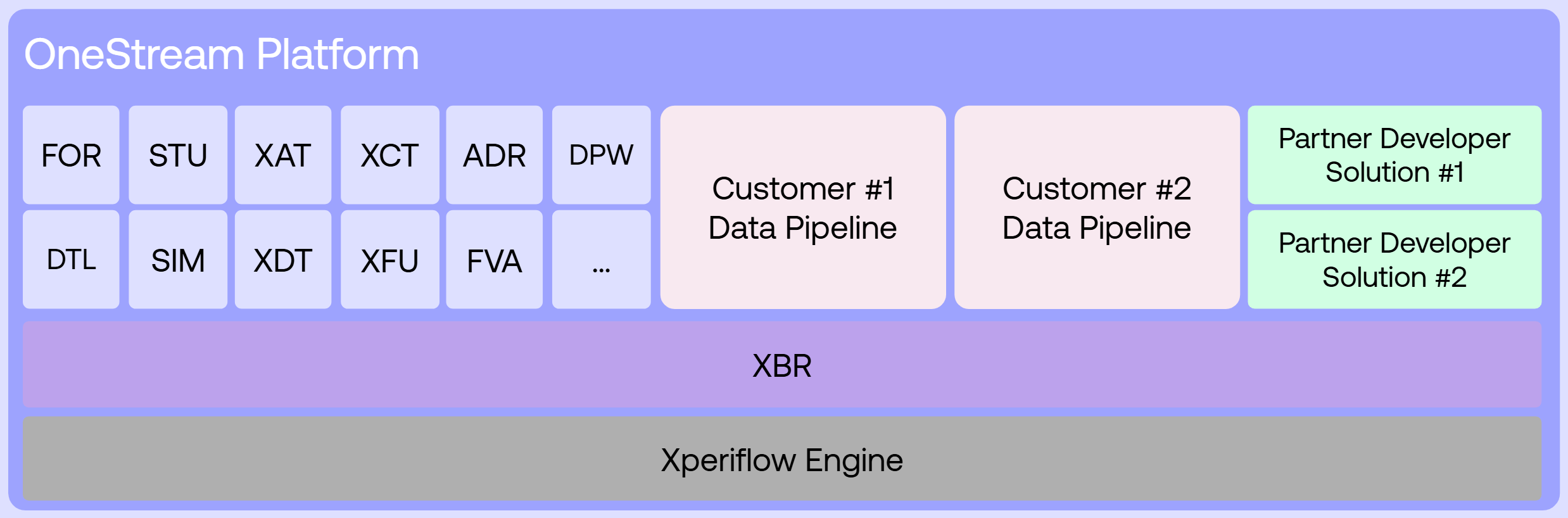
XBR - short for Xperiflow Business Rules - is a comprehensive .NET framework that enables OneStream developers to interact with the Xperiflow engine directly from within OneStream Business Rules. It provides a unified, type-safe API surface that abstracts the complexities of Xperiflow's underlying REST APIs, storage systems, and execution infrastructure into a familiar, developer-friendly programming model.
If you've developed OneStream solutions before, you're intimately familiar with the BRApi—the Business Rules API that serves as your gateway to OneStream's native platform capabilities. XBR follows this same design philosophy. Just as BRApi provides access to cubes, workflows, data management, and other OneStream subsystems, the XBRApi provides access to Xperiflow's capabilities.
XBR is leveraged by all SensibleAI-Powered Solutions.
The Problem XBR Solves
The finance industry is undergoing a profound transformation driven by artificial intelligence. Organizations that once relied solely on traditional consolidation, planning, and reporting workflows are now expected to incorporate predictive analytics, machine learning models, intelligent automation, and AI-assisted decision-making into their financial operations. The pace of change is relentless - what was cutting-edge last year is table stakes today.
OneStream has long been the platform of choice for enterprise financial consolidation and performance management. As AI becomes essential to staying competitive, finance teams face a critical question: How can we leverage AI capabilities to keep pace and outperform our competitors?
This is the problem XBR solves.
XBR provides the bridge that connects OneStream's robust financial platform with AI capabilities and infrastructure. Through XBR, developers can:
- Execute AI and machine learning routines hosted on Xperiflow’s scalable compute infrastructure, directly from OneStream Business Rules
- Process and prepare data for AI consumption using modern ETL capabilities that handle the formats and volumes AI workloads demand
- Store and retrieve artifacts, training data, predictions, and other AI outputs in Xperiflow’s data lakehouse
Without XBR, integrating AI capabilities into an OneStream solution would require custom middleware, manual data movement, and fragile point-to-point integrations. With XBR, these capabilities become native extensions of your existing development workflow - accessible through the same Business Rules you already write, using patterns you already know.
For organizations racing to modernize their finance function with AI, XBR isn't just a convenience - it's an imperative. It enables finance teams to move at the speed the market demands, delivering AI-powered solutions on the platform they already trust.
XBR’s Role in Solution Development
XBR serves as the bridge between OneStream and Xperiflow, enabling hybrid solution architectures that leverage the strengths of both platforms. In practice, this means:
Data Integration and Processing
When your solution needs to ingest data from external files, transform it, and load it into OneStream - or export data from OneStream Core for external consumption - XBR's ETL and MetaFileSystem modules provide the tools to accomplish this cleanly and efficiently.
Computational Offloading and Routine Execution
Modern AI and machine learning workflows rely on a rich ecosystem of tools, libraries, and frameworks - scikit-learn, TensorFlow, PyTorch, pandas, polars, and countless others - that have been developed and refined by the data science community over many years. Replicating these capabilities natively in .NET would be an enormous undertaking, and frankly, it's not where the AI innovation is happening.
XBR's Routines module gives you direct access to this world. Routines are the building blocks of AI/ML workflows on the OneStream platform. Through Routines, you can execute Python-based machine learning models, statistical analyses, and data science workloads - then seamlessly retrieve the results back into your OneStream Solutions and Business Rules. Whether you're running a trained classification model, generating forecasts, or performing feature engineering on large datasets, Routines make these AI capabilities a natural extension of your OneStream solution.
Workflow Orchestration
Complex business processes often require coordination across multiple steps, systems, and time intervals. XBR's Conduit module provides job orchestration capabilities that enable you to define, schedule, and monitor multi-step workflows.
Design Principles
XBR is built around several core design principles that shape how you'll interact with the framework:
Client-Based Architecture
Each XBR subsystem is accessed through a dedicated client object. You obtain these clients through factory methods on the XBRApi class, and the factory handles all the complex initialization - HTTP client configuration, authentication, dependency wiring - behind the scenes. This means you write minimal setup code and can focus on your business logic.
Asynchronous by Default
Many XBR operations involve network calls to Xperiflow services or long-running processes. The API embraces async/await patterns throughout, enabling you to write non-blocking code that scales well under load. You'll see methods like CreateRoutineInstanceAsync, WriteFileAsync, and WaitForCompletionAsync as you work through the modules.
Core OneStream Familiarity
XBR is designed to feel like a natural extension of the OneStream platform. It uses the same SessionInfo object you're already working with, integrates with OneStream's error handling and logging infrastructure, and follows familiar naming conventions and patterns.
Composability
The modules are designed to work together. A typical workflow might use the Routines module to execute a computation, retrieve artifacts from that run, process them with the ETL module, and store results using the MetaFileSystem - all orchestrated from a single Business Rule.